A study to assess the effectiveness of Laser and stretching versus Ultra sound and stretching in the treatment of Chronic Plantar Fasciitis – A Comparative study: Dr.Nuthakki Suneetha., M.P.T 1 Senior Physiotherapist, District Early Intervention Centre, Ongole, Andhra Pradesh ; Dr.Kurapati Madhava Reddy, Ph.D., D.Sc., Professor & Principal, Sri Lakshmi Institute of Medical Sciences College of Physiotherapy, Kavali, Andhra Pradesh, India2.
Background: Plantar fasciitis is the inflammation of the plantar fascia. Frequent injury or load to the plantar fascia can cause micro cracks or tears which can eventually lead to an inflammation and degeneration of the connective tissue in the fascia. [1,2] Plantar fasciitis affects adult population. Approximately 10% of patients with plantar fasciitis have development of persistent and often disabling symptoms.[3] Plantar fasciitis is a most common cause of inferior heel pain. The pain and discomfort associated with this condition have a dramatic impact on physical mobility. The etiology of this condition is not clearly understood and is probably multifunctional in nature. Obesity, occupation related activity, anatomical variation, poor biomechanics, over exertion and improper foot wear are contributing factors.[4] The most common cause of injury is overuse such as running, prolong standing, etc. which allow for repetitive micro trauma to the fascia. [5] Plantar fascia typically reveals some combination of either extrinsic or intrinsic factors that contributed to the development of the injury. Extrinsic factors suggested in the literature include training errors, training on unyielding surfaces and improper or excessively worn footwear. [6,7,8,9,10,11] Laser Therapy including Low-Level Laser Therapy (LLLT) and High-Intensity Laser Therapy (HILT) is used in plantar fasciitis treatment to accelerate tissue healing, reduce pain and decrease inflammation by stimulating cell activity through photo biomodulation and it has been considered as one of the physical therapy treatments in the chronic conditions that cause tightness and restriction in the soft tissues like plantar fasciitis. [12] Stretching exercise program plays an important role in treatment of plantar fasciitis and can correct weakness of intrinsic foot muscles. If there is pain with the first few steps in morning, massage and stretching the plantar fascia itself before getting out of bed may help. [13, 14] There are various studies available proving the individual effect of Laser therapy and stretching technique and ultrasound therapy for treating plantar fasciitis. Hence in the present study a comparative analysis was made to find the effectiveness of Laser and stretching versus Ultrasound and stretching in reducing the pain and improving the foot function in patients suffering from chronic plantar fasciitis.
Aims & Objectives: The aim and objective of the study is to compare the effectiveness of Laser and stretching over Ultrasound and stretching in reducing pain and improving foot function in patients with chronic plantar fasciitis.
Method: The chief objective of this study was to compare the efficacy of Laser and stretching over Ultrasound therapy and stretching in patients with chronic planter fasciitis in reducing the pain intensity and improving the foot function assessed by VAS and FFI respectively. Overall, 60 subjects who met with the inclusion criteria were randomly allocated into two groups. The subjects, who fell into age group of 40-60 yrs. of both the sexes and who were suffering from chronic plantar fasciitis were selected. 30 subjects from Group 1 were treated with Laser and stretching while 30 subjects from Group 2 were treated with Ultrasound therapy and stretching. Pretreatment
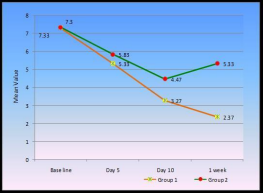
values of pain intensity using VAS and foot function using FFI on baseline, day 5, day 10 and 1 week after were assessed. These values were statistically analyzed using repeated measures of ANOVA test and Mauchly’s Chi- square test. The statistical analysis done for both the groups showed reduction in pain intensity and improvements in foot function. Results: Results also showed that subjects from group 1 showed more improvements in foot function and reduction from baseline to day 10 of treatment and maintained the improvements till after 1 week of day 10. Whereas subjects from group 2 showed improvements from baseline to day 10 till the treatment was given to them but showed mild increase in pain and reduced foot function after the treatment was stopped. They showed mild increase in pain levels and slightly reduced foot function compared to day 10- and 1-week measurements. Hence, group 1 treated with Laser and stretching showed higher significance than Group 2 treated with
Ultrasound therapy and Laser. Based on this data we accept the alternate hypothesis and reject the null hypothesis. These results were significant at P=0.001 and it strongly supports the earlier findings of Suman Kuhar (2007)15 who took 30 subjects and separated them into 2 groups. One group received therapeutic ultrasound and contrast bath for 20 minutes with foot intrinsic muscles strengthening exercises and plantar fascia stretching exercises and other group received conventional treatment. The outcome was assessed in terms of foot function index and visual analog scale.
Comparison of VAS scores in group 1 and group 2 It concluded that Laser along with Stretching is effective therapeutic option in treatment of plantar fasciitis.[15] The results of this study also has got strong evidences from the study done by Barnes JF (1990) who said that Laser is based in the idea
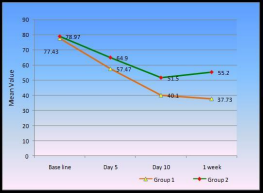
that poor posture physical injury, illness and emotional stress can cause the fascia to become fat and constricted throughout the body (fascia links every organ and tissue in the body with every other part); the skillful and dexterous use of hands is said to free up or release disruptions in these facial network. Pressure on the bones, muscles, joints and nerves is released in the process and balance is restored. Comparison of foot function index scores in group 1 and group 2
Conclusion: This study can be concluded by stating that both Laser technique and stretching and Ultrasound therapy and Stretching have got beneficial effect in reducing the pain intensity and improving the foot function in patients with chronic plantar fasciitis. Both the treatments showed significance in reducing the pain levels and improving the foot function from baseline to day 10 of treatment. But only subjects in group 1 showed improvements in measurements taken in the follow up 1 week. Group 2 subjects came back with mild increase in pain levels and reduced foot function in the follow up measurements. When both the treatment regimens were taken into consideration for significance, the Laser and stretching, Ultrasound therapy and stretching showed effectiveness in reducing the pain intensity and increasing the foot function but Laser and stretching showed superior hand over Ultrasound therapy and stretching.
Keywords: Chronic plantar fasciitis, Laser, stretching technique, Ultrasound, pain intensity, foot function, visual analogue scale, foot function index.
References:
1. Daniel L., Riddle et al. Risk factors for plantar fasciitis: A matched case-control study. The Journal of Bone and Joint Surgery (American) 2003; 85: 872-77 2. Robert Donatelli, Steven L Wolf. The biomechanics of the foot and ankle. F A Davis, Philedelphia 1990;141-156.
3. Benedict F., Digivonni et al. Tissue Specific plantar fascia stretching exercise enhances outcomes in patients with chronic heel pain. The Journal of Bone and Joint Surgery 2003.
4. Pfeffer G, Baccheti P, Deland J et al. Comparison of custom and prefabricated orthoses in the initial treatment of proximal plantar fasciitis 1999;20(4):214-21 5. Young B, Walker MJ et al. A combined treatment approach emphasizing impairment based manual physical therapy for plantar heel pain: a case series. JOSPT 2004; 34:725-33.
6. Cailliet R. Foot and Ankle pain. F A Davis, Philadelphia 2005;95 7. Mario Roxas, ND. Plantar Fasciitis: Diagnosis and Therapeutic considerations. Alternative Medicine Review 2005; 10(2): 83-93.
8. Cornwall M, McPoil T. Plantar fasciitis- etiology and treatment. J Orhto Sports Phys Ther 1999;29(12):756-60
9. Crawford F, Atkins D, Edwards J. Intervention for treating plantar heel pain, Foot 2002;11:228-250.
10.Simon J. Bartold. Plantar heel pain syndrome: overview and management. Journal of bodywork and movement therapies 2004;214-226.
11.David C Reid. Sports injury assessment and rehabilitation, 1st Ed. Churchill Livingstone, London Philedelphia 1992;226-35.
12.Schepsis AA, Leach RE, Gorzyca J. Plantar fasciitis- etiology, treatment, surgical results and review of literature. Clin Orthop 1991; 266:185-96.
13.Daniel. Rehabilitating Plantar Fasciitis 2007.
14.Powell M, Post WR, Kenerj, Wearden S. Effective treatment of chronic plantar fasciitis with dorsiflexion night splint; a cross over prospective randomized outcome study. Foot ankle 1998; 19:10-80.
15.Barnes JF. Laser- the search of excellence rehabilitation service. PA medicine 1990; 25:721-25.
16.Suman Kuhar. Effectiveness of Laser in treatment of plantar fasciitis. Indian Journal of Physical Therapy and Occupational Therapy.